Pages

Showing posts with label Visuals. Show all posts

Tuesday, July 8, 2014

Recognizing the Lord's Hand in Our Lives through Analogy

This past week in Sunday School we listened to a rendition of "The Lord is My Shepherd" (Psalm 23). As we listened, I remembered an article I read years ago in an old book of my grandma's entitled "The Basque Sheepherder and the Shepherd Psalm" by James K. Wallace*. The author was a Basque sheepherder from Nevada who goes into detail about each line of the Psalm and what it means to a shepherd.

What struck me as we listed was how David (the author of the Psalm) was able to see the Lord's hand in his daily life, not just in scriptures and ancient prophecies. He was able to draw analogies between his work/training to his relationship to the Lord.

I love the idea of looking for the Lord in all that you do, because I think we all learn better when things can be applied to our daily actions. Here are a few examples that have come up in our family recently:

1. Apostasy and Restoration. Andrew asked us the other day what "Catholic" meant. I explained that it was another religion, then he asked if it was "a good religion." I explained that there are many great people who are Catholic and that my dad was even raised Catholic. As I started to explain about how lots of churches have bits of truth, he responded, "Yeah! It's like the blocks! In Primary they built a church out of blocks then knocked it down to show how all the pieces broke apart after Jesus died" [apostasy]. Even Emma (age 4) remembered the object lesson and chimed in with a few details about how the church was broken and needed to be put back together [restoration].
Both kids love to build with blocks, so it was an easy way for them to not only understand about the Apostasy and Restoration, but to be able to retell it to us later.

~

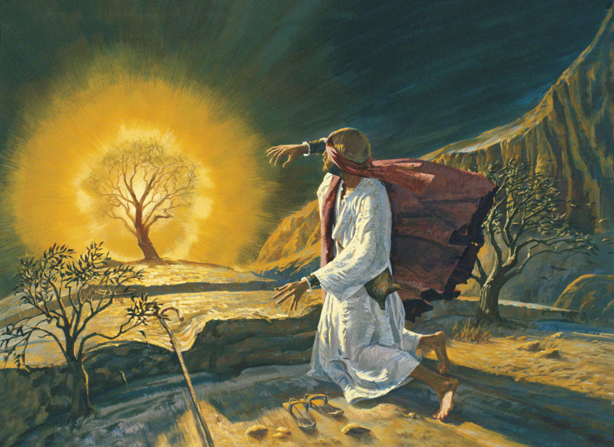
2. Lord's Personalized Care for Us. Because of my training as a speech therapist, I always like stories about communication and struggles with communication. I am fascinated by two stories of stuttering (or "slowness of speech") in the scriptures. Both Moses and Enoch describe themselves as being slow of speech and ask the Lord to help them in their ministries. Although they both suffer from the same basic ailment, the Lord provides individualized solutions for each of them. Moses is granted a spokesperson, while Enoch is given the words to say.
I know from personal experience how important it is to take into consideration a client's situation, personality, family support, and abilities when teaching communication skills, and I love to see how the Lord demonstrates that as well. It helps me apply that to my own life, and recognize that the Lord will help me, bless me, and challenge me in ways different from those around me.

~

I think even the Lord recognized how important it is for us to see His hand in our lives daily, because he frequently taught using parables that his disciples could apply to their common situations (gardening, fishing, caring for children or animals, etc.). And I always find the talks in church or Conference most memorable when they include stories from the speaker's personal lives to help draw analogies and teach principles.

What are some ways that your education, experiences, or training have helped you see the Lord's hand in your lives in a different way than you otherwise would have?

Tuesday, March 11, 2014

Ways to Use Pictures with Kids

Kids have an amazing ability to learn, though sometimes it takes a while for them to be able to verbalize their knowledge, needs, or wants. I love to incorporate some non-verbal means of communication into my interactions to help kids express themselves more easily. Kids are very observant and quite visual, so I find myself using pictures with not only the kids I work with as a speech therapist, but also with kids at church and my own kids at home. Here are some ways I love to use pictures:

Make an activity choice chart. When my kids were having trouble thinking of things to do to entertain themselves, I put together a chart that had pictures of a bunch of activities I knew they liked. I stuck it in a sheet protector and hung it on the fridge. Then, whenever they complained of boredom, I just pointed to the list and said, "Pick anything you want!" They felt very powerful having so many options and I loved being able to say, "Yes! You can do that!"

Make a chore chart. Some kids love being able to be in charge of their own chores and routines, but their level of "doneness" may not be up to our standards. When you provide pictures of what needs to be done, the child can visualize how much is left. The pictures can be pulled off the chart, covered up, crossed off, etc. to provide a visualization of completion. I used pictures like this on a chore chart for Andrew that had flaps to fold down over each item when they were complete.

Make a schedule. When I teach primary or preschool or work with certain kids as a speech therapist, I use a picture schedule. This consists of laminated pictures that are attached to a schedule board with velcro. As each item is completed, it's pulled off and put in an "all done" pocket or envelope. Kids can even help choose the order of the pictures when you put them on the schedule (then it's their own fault if they don't like what comes next!). If you don't have the fancy laminated pictures to use over and over, you can always draw one or create one on the computer. Kids can cross off the pictures as they complete each item. We even use schedules for birthday parties to keep the craziness somewhat under control.

Tell stories. My kids love when Dad tells stories and draws pictures at the same time. Andrew has always loved to draw, and it's almost as much fun to watch the process as it is to see the finished product because he tells such fun stories while drawing.

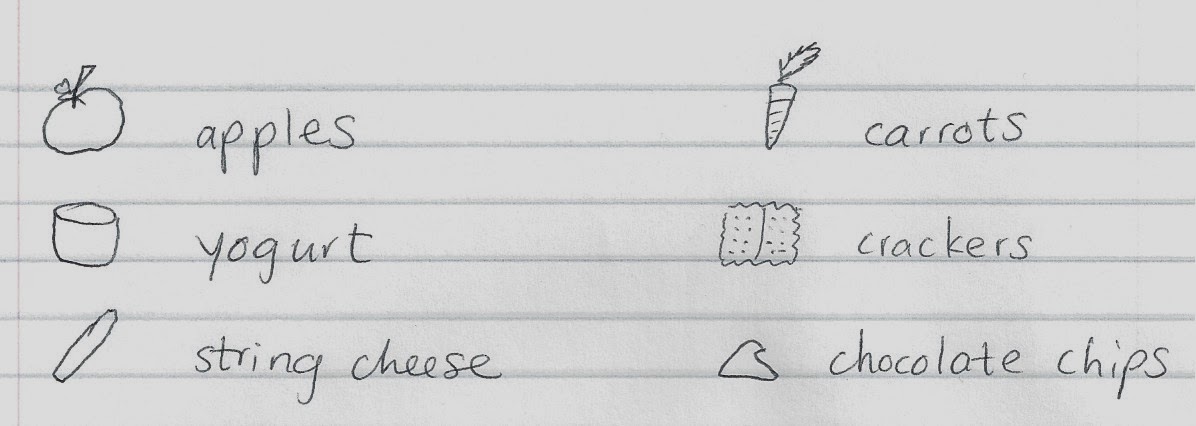
Make a kid shopping list. I hate grocery shopping. I really hate grocery shopping with children. I try to take advantage of the Fred Meyer nearby because they have a kid's land for the little ones to play (supervised by a sweet old lady who works there) while I shop. But when it's full or we are there before it opens, I sometimes have to be creative to keep the kids from tearing each other's hair out. One thing they have enjoyed is a small sheet of paper with their own "grocery list" (pictures I drew of some of the foods we need). I always choose things they really like so they are extra motivated to make sure we remember them. They get to cross it off the list when we put it in the basket.

Teach songs. There are so many resources on the internet that contain visuals to go along with Primary songs. Try working on the Primary song for the month (Did you know Primary kids work on the same song Church-wide for several months of the year? Find them in the Outline for Sharing Time on lds.org) during FHE each week. Print off pictures for the kids to follow along.

What are ways you have used pictures with your kids or with other kids you've worked with?